Visual History · Bengal School
Nationalism,
Violence, and the
Bengal School
A Country Learning to Paint Itself Too Hard
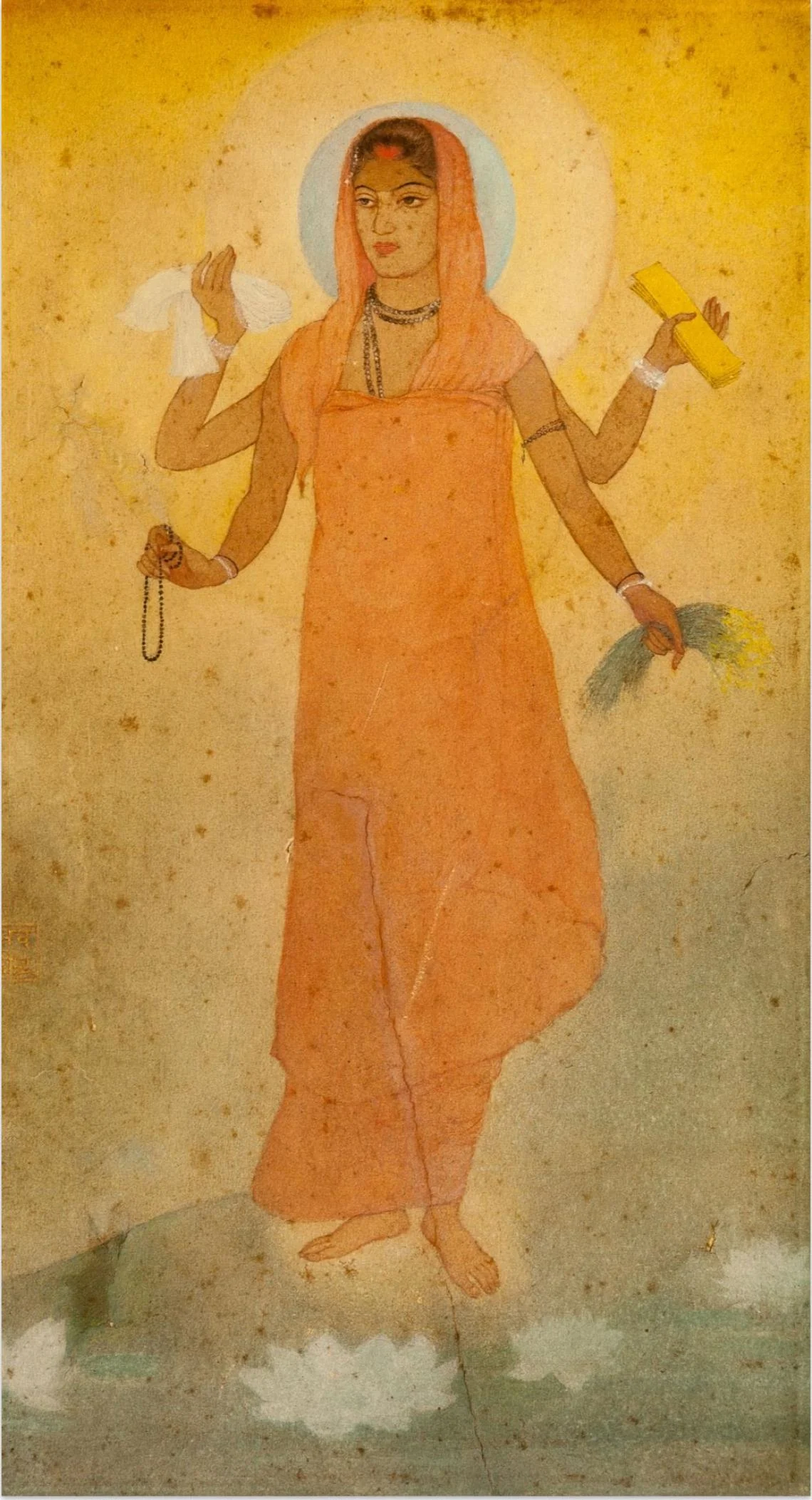
Bharat Mata · Abanindranath Tagore · 1905
Watercolour on paper · Victoria Memorial Hall, Kolkata
The trouble with nationalism is that it often begins as recovery and ends as accusation. In colonial India, nationalism was, at least in one of its nobler moods, a method of self-rescue. The people humiliated by the empire tried to gather the broken pieces of their past and say: we are not merely subjects; we are makers of meaning. The Bengal School of Art belongs to this moment. It was not innocent, but it was searching. It was trying to imagine India before India had become a flag permanently clenched in someone's fist.
Abanindranath Tagore's Bharat Mata is the obvious starting point. Painted in 1905, in the atmosphere of Swadeshi and the Partition of Bengal, it gives the nation a body. But what kind of body? Not the muscular, shouting, weaponised body that dominates the political poster today. She is ascetic, almost withdrawn. She carries food, cloth, knowledge, and prayer. She does not command; she offers. She is not yet the Bharat Mata of rallies, slogans and compulsory reverence. She is a fragile proposition.
This is where the comparison with the present becomes painful. Today's violent nationalism is not merely love of nation intensified. It is love made suspicious, love trained to look for enemies. The nation is no longer imagined as a shared inheritance but as a disputed property, with some declared natural owners and others reduced to tenants, trespassers, infiltrators, and historical pollutants.
"She does not command; she offers.
She is not yet the Bharat Mata of rallies.
She is a fragile proposition."Bengal School and the national image
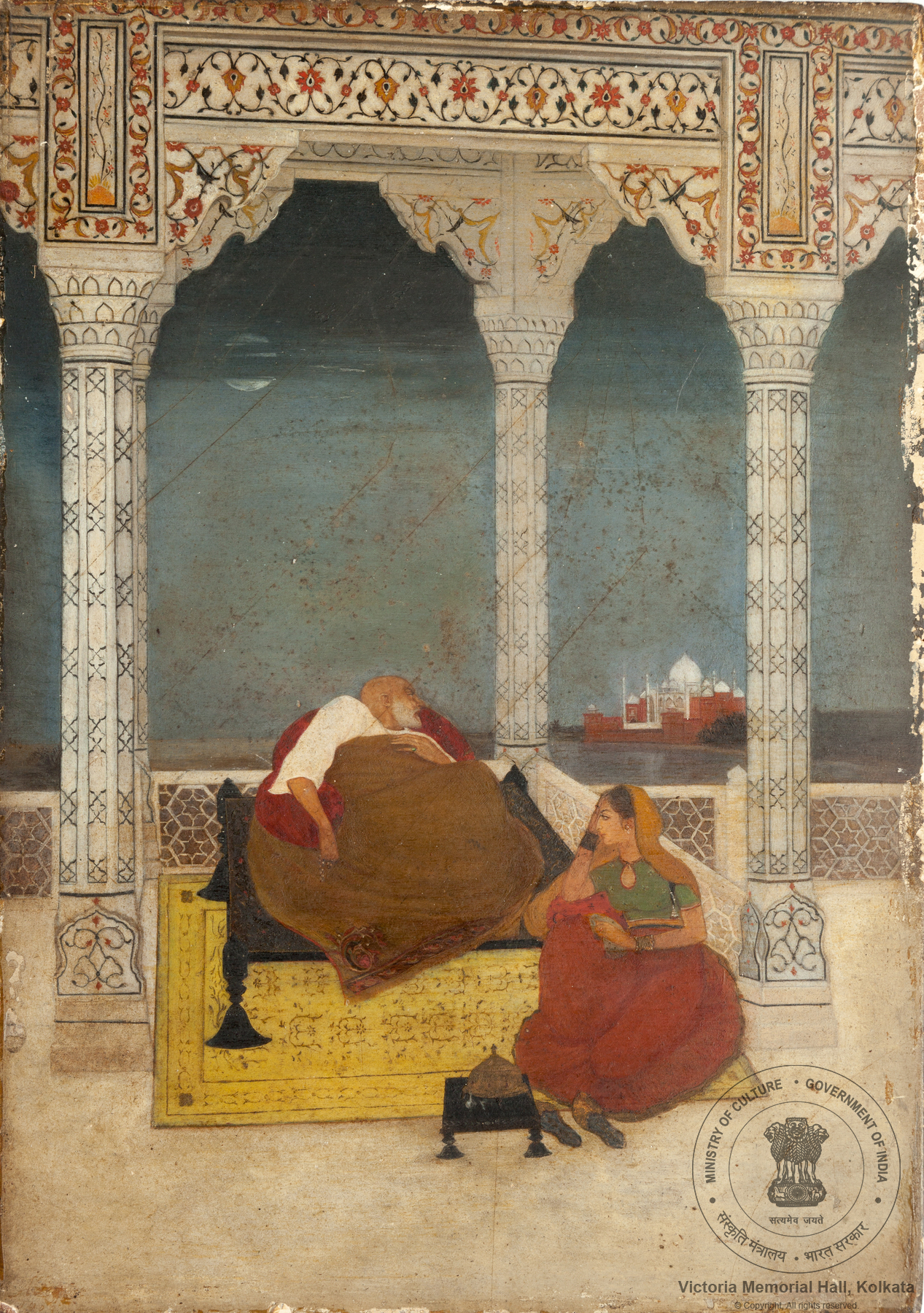
The Passing of Shah Jahan · Abanindranath Tagore · 1902
Tempera on board · Victoria Memorial Hall, Kolkata
The historian Romila Thapar has long warned against this flattening of India's past into a single religious narrative. India, in her telling, is not a civilisation of one voice but a continuous argument: Buddhist, Jain, Brahmanical, Persianate, Islamic, regional, vernacular, tribal, colonial, modern. To make it singular is not to honour it. It is to vandalise it. Christophe Jaffrelot gives this process a political vocabulary: majoritarian nationalism, ethnic democracy, the conversion of electoral strength into cultural entitlement.
Pratap Bhanu Mehta sees another layer: the slow weakening of institutions that once mediated conflict. The court, university, press, bureaucracy, parliament - all these become less like constitutional structures and more like stage props arranged around power. Journalists such as Siddharth Varadarajan, Rana Ayyub, and Hartosh Singh Bal have written, in different ways, of the cost of dissent in such a climate: the public intellectual becomes suspect, the minority becomes conditional, the critic becomes anti-national.
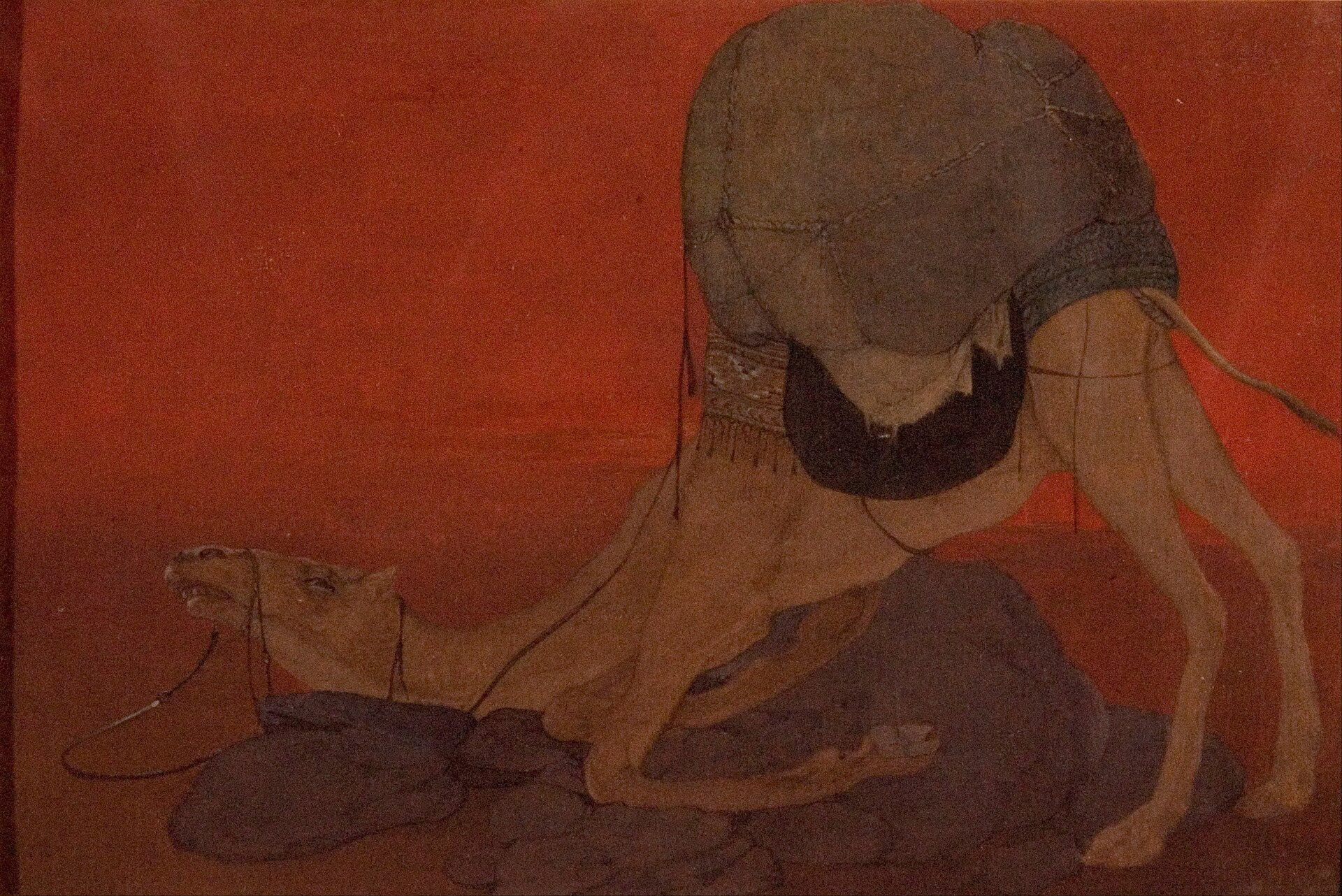
Journey's End · Abanindranath Tagore · 1913
Tempera on cloth
The Bengal School, too, was political. But its politics lay in choice: what to inherit, what to reject, what to revive, what to soften. Its artists rejected colonial academic realism not only as style but as hierarchy. European naturalism had arrived with the authority of the empire, carrying with it the assumption that to paint correctly was to paint like Europe.
The Bengal School refused this. It turned to Mughal miniatures, Rajput painting, Ajanta, Japanese wash techniques, devotional lyricism, and a deliberately anti-industrial delicacy. This was nationalism as aesthetic disobedience. But it was also selective. That is the first important similarity between the Bengal School and contemporary nationalism: both understand the power of choosing the past.
No nationalism inherits the past whole. It edits. It frames. It illuminates one corner and darkens another. The Bengal School chose a spiritual, refined, civilisational India against the material arrogance of the empire. Contemporary majoritarian nationalism chooses a wounded, glorious, betrayed Hindu India against the imagined enemies of history.
"Its beauty came from impurity - from a mixture
so old that it had forgotten the moment of mixing."On the porous national image
The difference lies in what each selection does to the other. The Bengal School's nationalism, for all its romanticism, remained porous. It borrowed from Mughal and Persianate traditions even while seeking an indigenous idiom. Its India was not ethnically sealed. It was not pure. In fact, its beauty came from impurity - from a mixture so old that it had forgotten the moment of mixing.
Contemporary violent nationalism, by contrast, often behaves as if mixture is contamination. It wants origins without sediment, identity without overlap, history without embarrassment. This is why the Bengal School is such a useful mirror. It shows us that cultural nationalism need not automatically become hatred. It can be inward-looking without being exclusionary. It can be anti-colonial without being anti-minority.
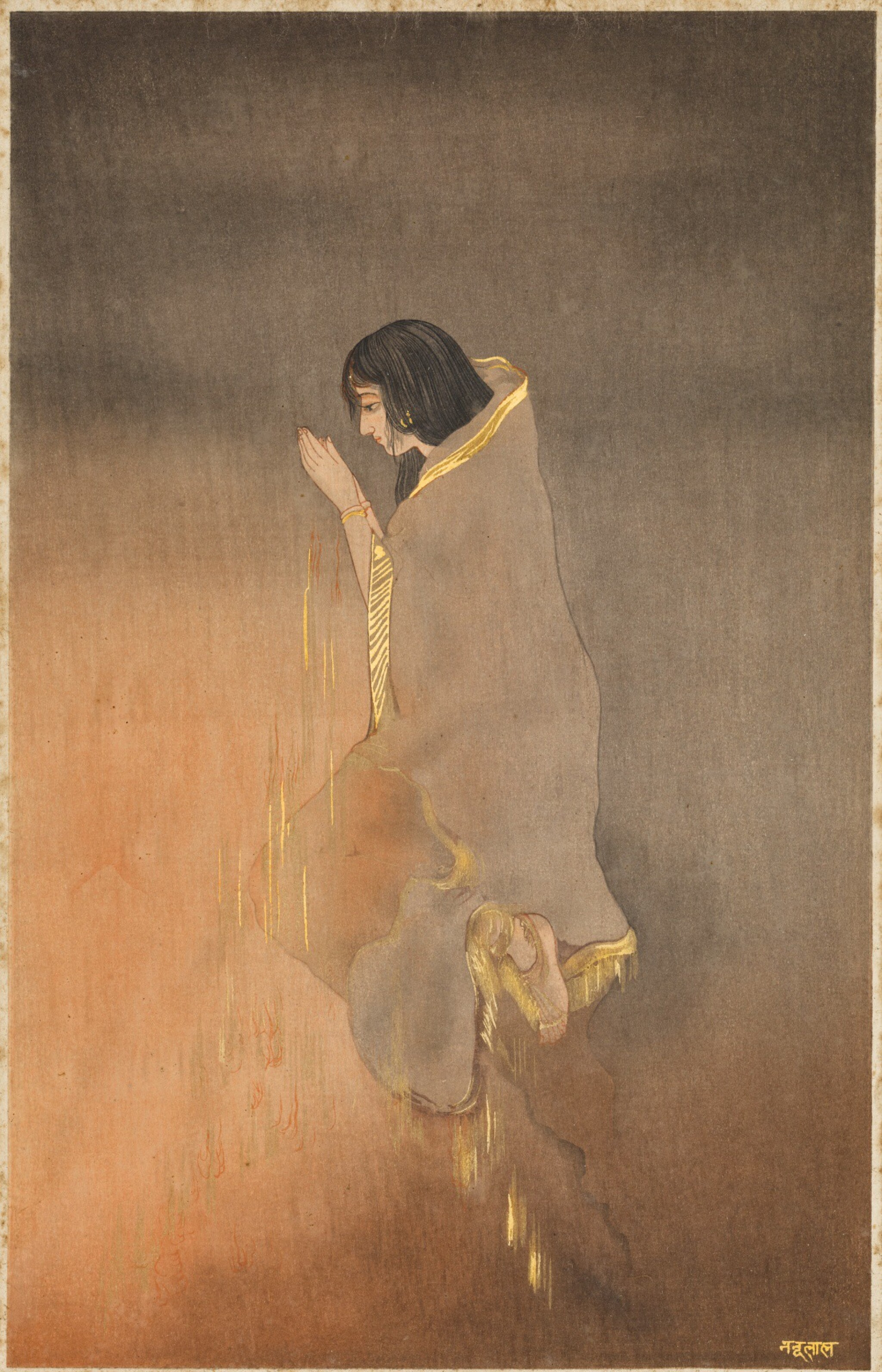
Sati · Nandalal Bose · 1908
Watercolour on paper
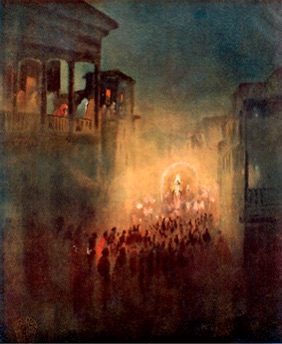
Durga Pratima Visarjana · Gaganendranath Tagore · 1915
Oil on canvas
Yet one must not romanticise it too much. The Bengal School had its own silences. Its India was often feminine, spiritual, rural, upper-caste, devotional, melancholic. It did not always know what to do with labour, Dalit histories, women as political subjects rather than allegories, the brutalities of caste, the modern city, the machine, the crowd.
Its rejection of the West sometimes became an overcorrection into the mystical East. It gave India a soul, but perhaps not always a street, a factory, a courtroom, or hunger. This is where a historian like Thapar becomes necessary. She would ask: whose past is being recovered? Who is authorised to speak for civilisation? What happens when myth becomes archive?
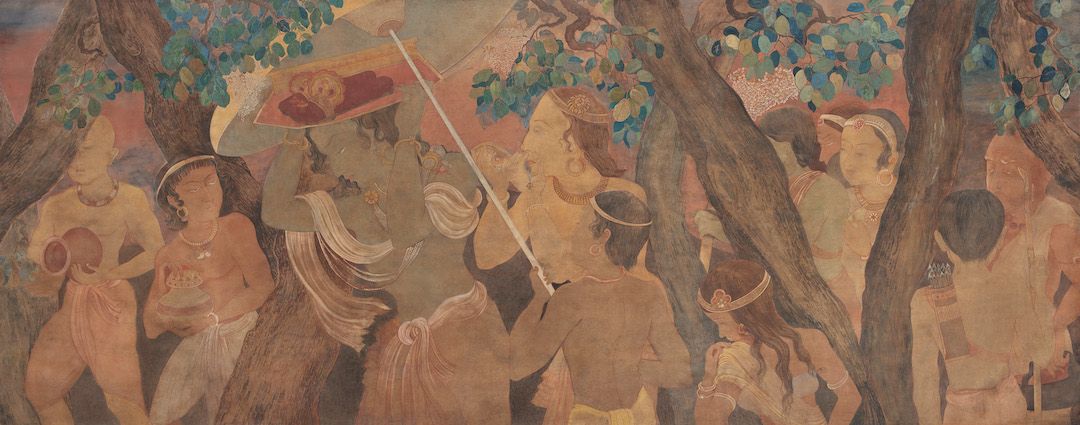
Untitled (The Procession) · Asit Kumar Haldar · 1950
"A nation is also an image.
Before people kill for it,
they must first imagine it."
And yet, art understands something politics forgets: that a nation is also an image. Before people kill for it, vote for it, police it, they must first imagine it. The battle for India has always been, partly, a battle over representation. Is India a mother? A goddess? A map? A constitution? A temple? A wound? A market? A mob? A river system? A language family?
A memory of Partition? A queue outside a ration shop? A young Muslim man being asked to prove his belonging? A tribal village resisting extraction? A painting in wash technique, almost disappearing into its own light? The Bengal School made symbols. Historians distrust symbols when they begin to behave like facts.
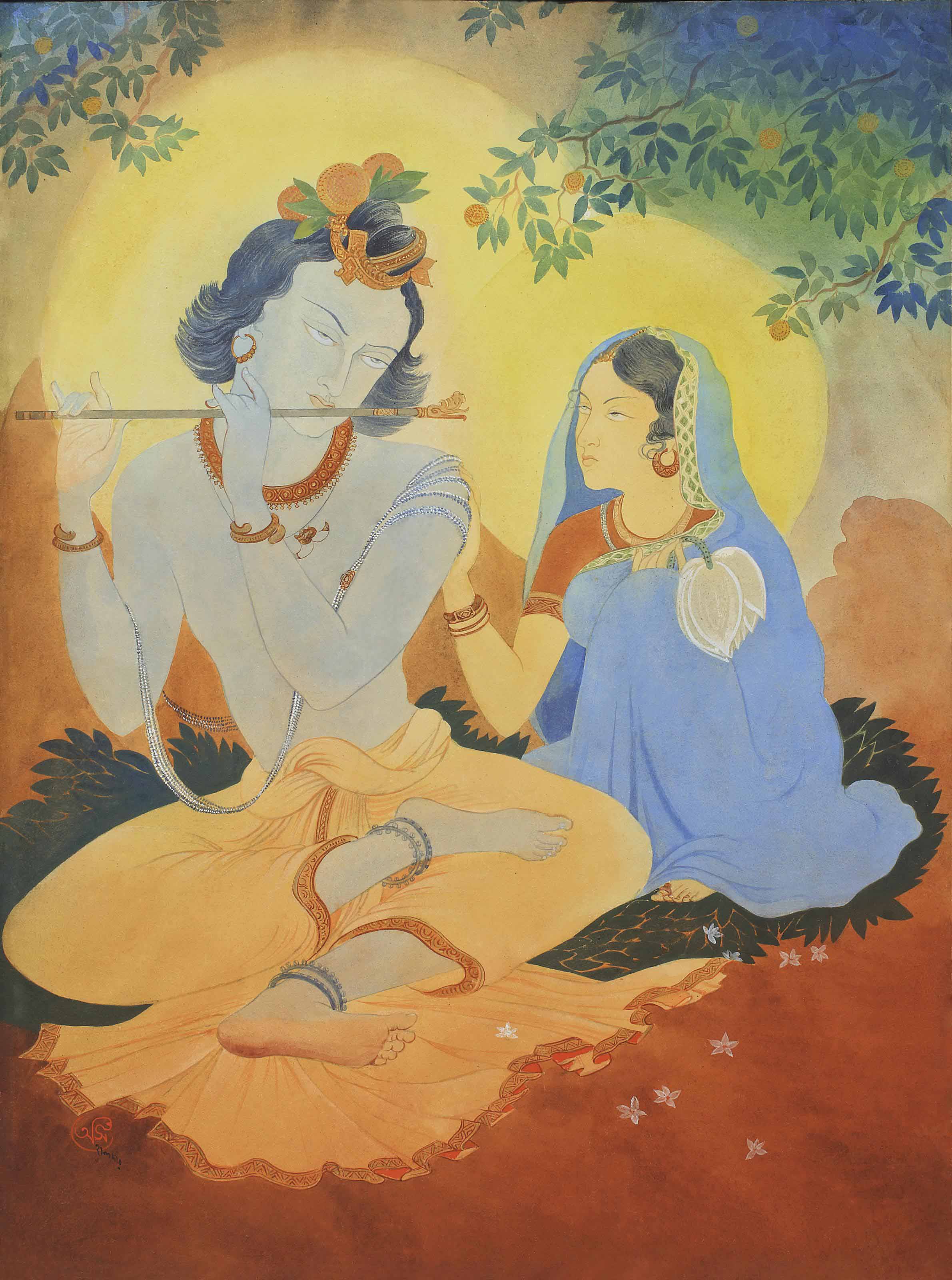
Untitled (Krishna) · Asit Kumar Haldar · 1940
Watercolour on paper
The present has chosen hard lines. The Bengal School chose blurred ones. Bengal School painting often works through wash, through suggestion, through atmosphere. Forms emerge slowly. Borders are not aggressively enforced. Colour seeps, fades, trembles. Contemporary nationalism does the opposite. It outlines everything in thick black: Hindu/Muslim, national/anti-national, loyal/traitor, pure/impure, ancient/foreign. It has no patience for gradation. Violence begins where shading ends.
The Bengal School's politics of choice was a politics of recovery. Today's violent nationalism is often a politics of revenge. The first asks, "What have we lost?" The second asks, "Who made us lose it?" The first turns to art, education, craft, language, memory. The second turns to surveillance, humiliation, spectacle, punishment. The first may be naive; the second is dangerous.
Still, both remind us that nationalism is never natural. It is made. Painted. Printed. Sung. Taught. Televised. Forwarded on WhatsApp. Installed in schoolbooks. Lit up on buildings. Repeated until it feels older than it is. The Bengal School helped paint one India into being: wounded but graceful, colonised but self-searching, spiritualised, syncretic, aesthetic, anti-imperial. Our present is painting another: muscular, resentful, majoritarian, impatient with doubt.
The question is not whether art and nationalism are connected. They always are.
The question is: what kind of nation does the art permit us to feel? A generous nationalism leaves space around the figure. An intolerant one fills the whole canvas with itself.