Visual History · Calendar Art
Raja Ravi
Varma and the
Birth of Calendar Art
Aesthetic Democratisation or Cultural Flattening?
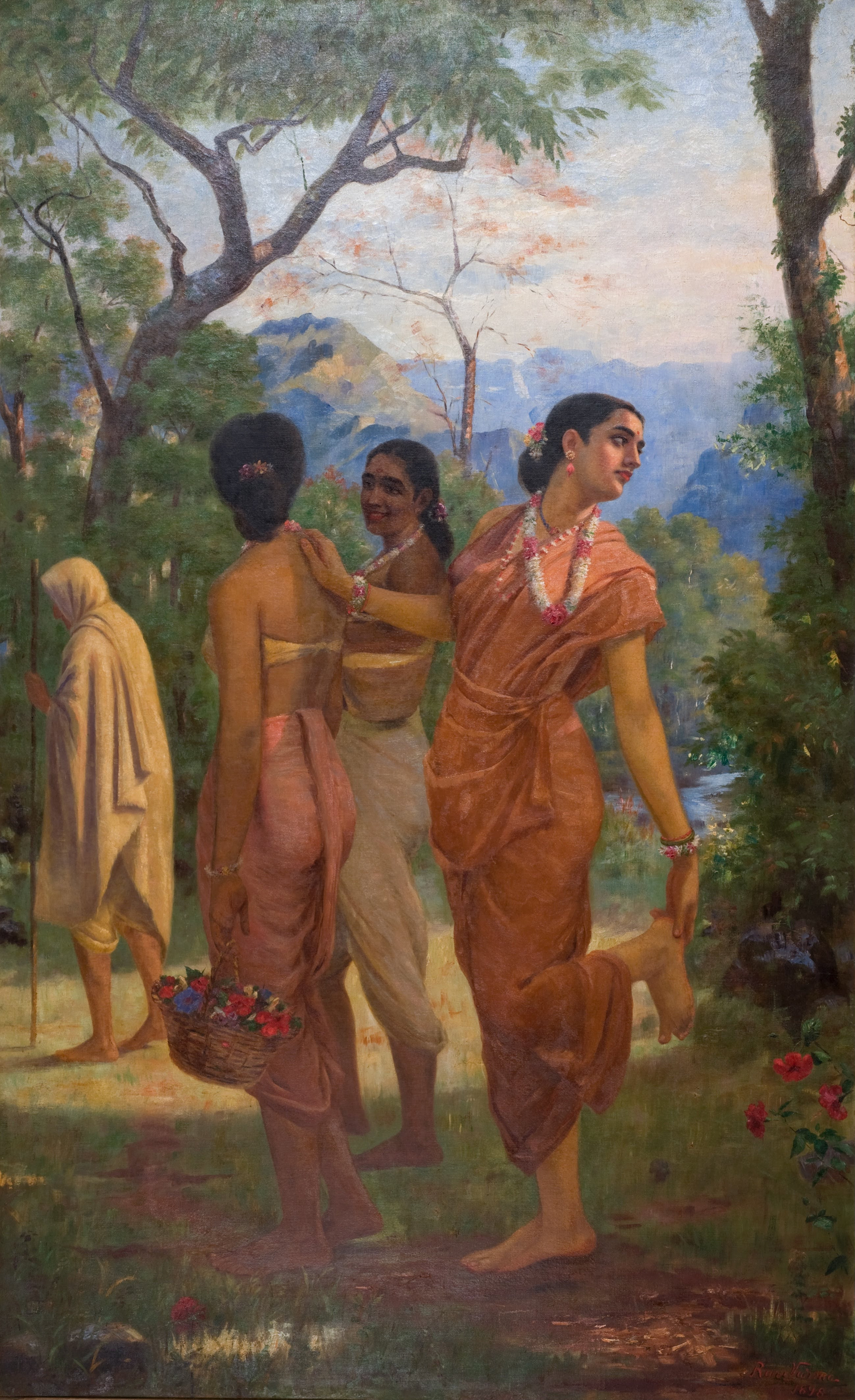
Shakuntala · Raja Ravi Varma · c.1870
Oil on canvas · Baroda Museum and Picture Gallery
There are few figures in Indian art history as paradoxical and as persistently misunderstood as Raja Ravi Varma. To speak of him is to enter a contested terrain, one where oil paint meets mythology, where colonial modernity negotiates with indigenous imagination, and where the sacred is, quite literally, mass-produced.
Ravi Varma's work emerges at a precise historical juncture: the consolidation of British colonial rule and the accompanying influx of European academic realism into Indian visual culture. Trained in oil painting and influenced by Victorian academic styles, he adopted chiaroscuro, anatomical naturalism, and perspectival depth.
His subjects, however, remained resolutely Indian. Drawing from the Mahabharata, the Ramayana, and the Puranic imagination, he rendered Shakuntala, Damayanti, Saraswati, Lakshmi, Krishna, and Arjuna with a corporeality that was unprecedented in popular Indian visual culture.
"Gods and goddesses were no longer symbolic or stylised.
They became embodied, sensual,
and crucially, humanised."Ravi Varma and the visible divine
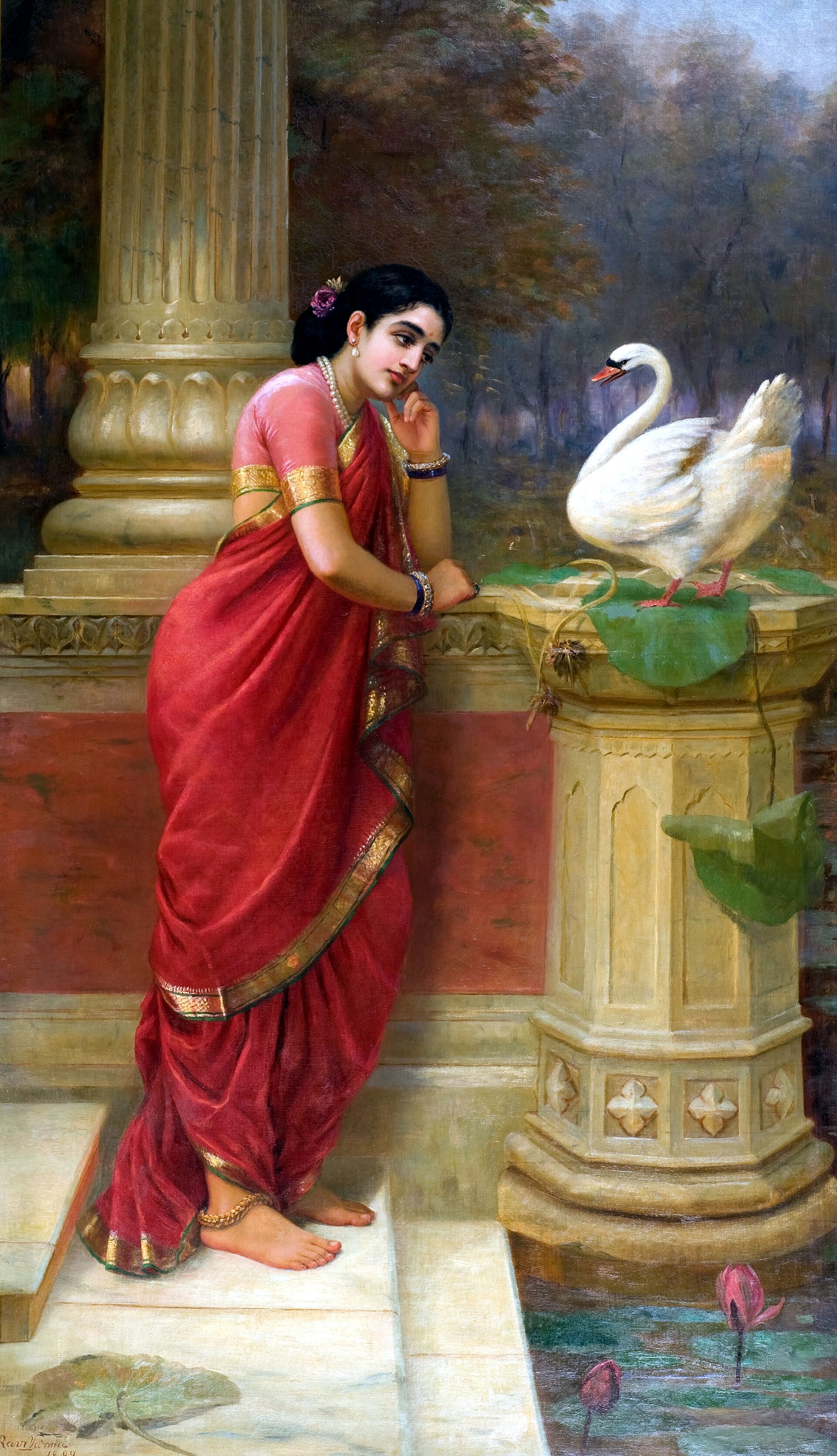
Damayanti and the Swan · Raja Ravi Varma · c.1899
Oil on canvas
This synthesis of European technique applied to Indian myth was not merely aesthetic. It was ideological. It created a visual language through which a colonised society could see itself in forms that were globally legible, even as it risked internalising the visual grammar of the coloniser.
The critic Partha Mitter has argued that Ravi Varma was neither fully subservient to the European model nor entirely free of it. He was caught, brilliantly and productively, in between. That in-between space gave his work its peculiar power and its persistent controversy.
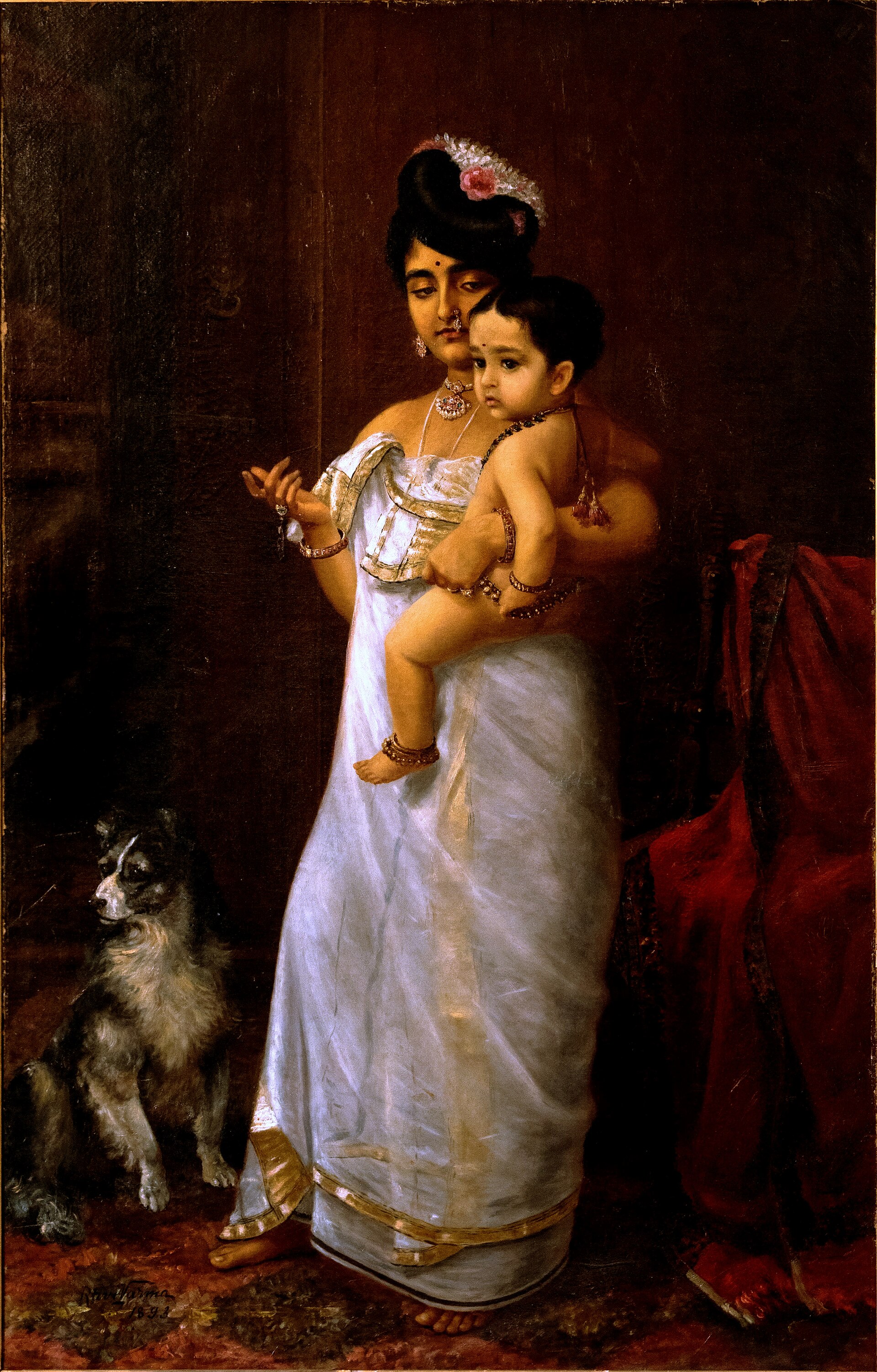
There Comes Papa · Raja Ravi Varma · 1893
Oil on canvas
The true rupture lies not just in Ravi Varma's paintings but in his entrepreneurial foresight. In 1894, he established the Ravi Varma Fine Arts Lithographic Press, enabling the mass reproduction of his works. Here, art exits the palace and enters the bazaar.
Through oleographs, cheap and reproducible prints, images of Lakshmi standing on a lotus or Saraswati holding a veena found their way into middle-class homes, shops, prayer corners, railway offices, and eventually calendars. The sacred image was no longer mediated by temple or priest.
This is the moment when art becomes portable devotion. The divine became democratic, not as a planned ideology but as a consequence of technology. The printing press distributed myth, and in distributing it, transformed its meaning entirely.
"The sacred image was no longer guarded by distance.
It was pinned to a wall,
next to a clock or a grocery list."The press as portable shrine
The phrase calendar art is often used pejoratively, implying kitsch, sentimentality, and a lack of artistic rigor. It is frequently mobilised to draw a boundary between high art and popular culture. But such a distinction reveals more about the anxieties of critics than about the art itself.
To dismiss Ravi Varma's reproductions as mere calendar art is to overlook the radical democratisation they represent. For the first time, visual access to divine iconography was not restricted by class or caste. The image became a site of cultural participation.
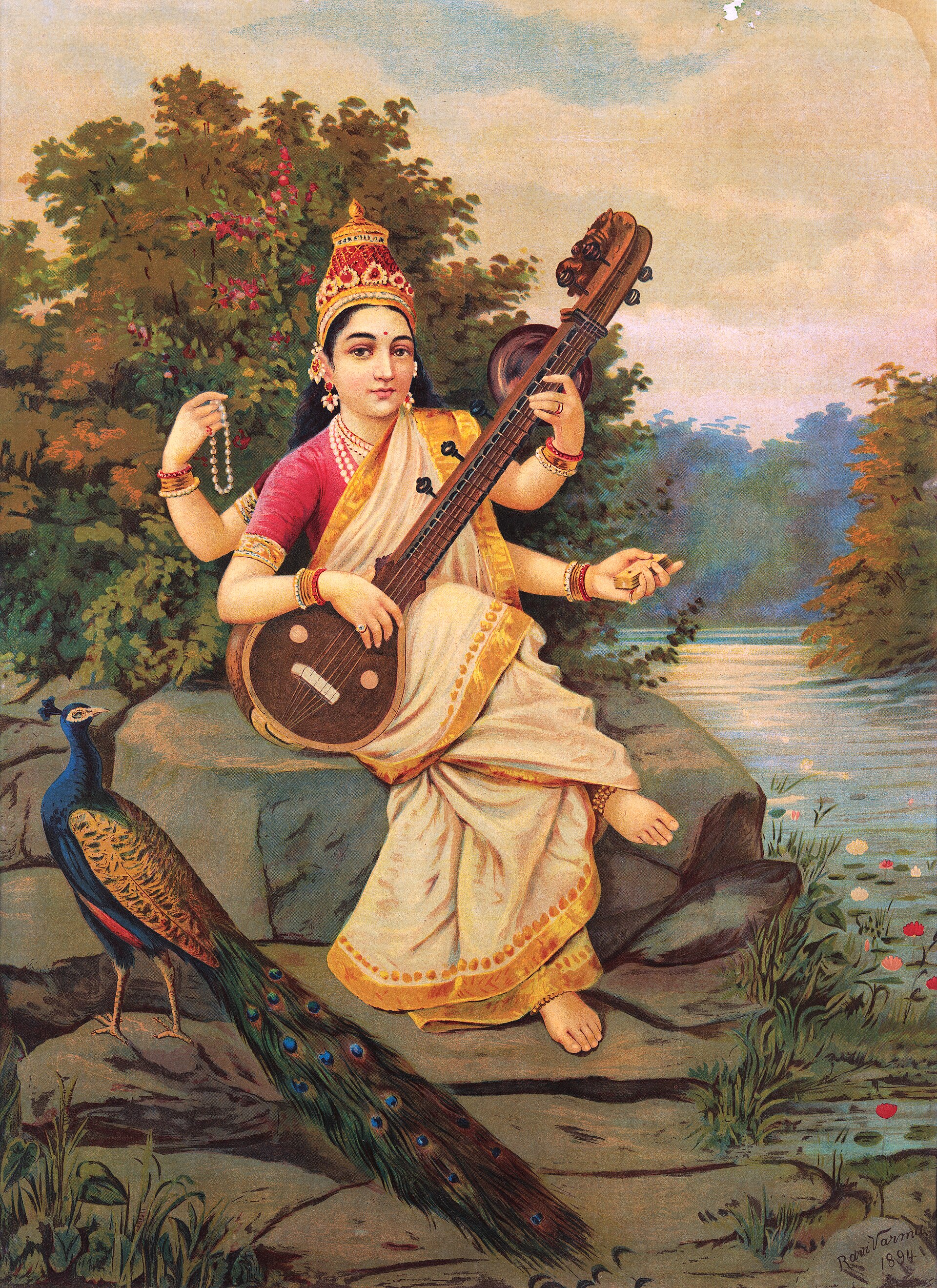
Saraswati · Raja Ravi Varma · 1896
Oleograph print · Ravi Varma Press
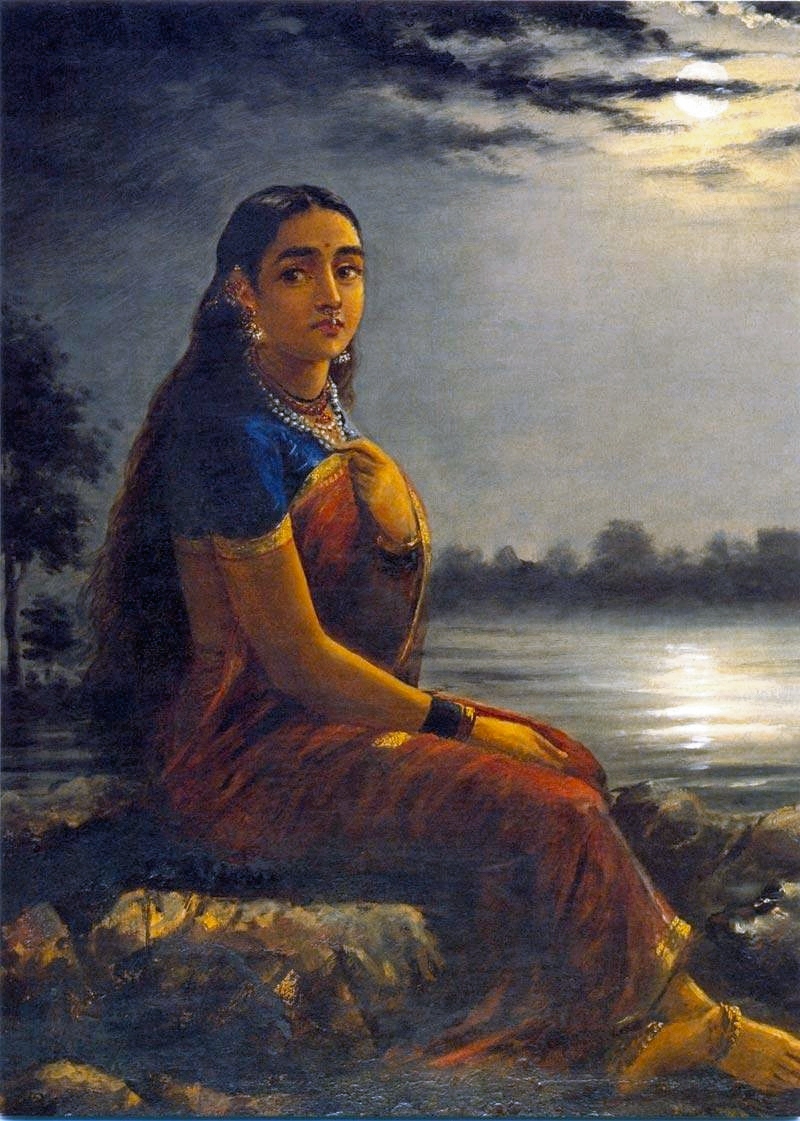
Lady in Moonlight · Raja Ravi Varma
Oil on canvas
Yet democratisation came with flattening. Repetition standardised the divine. Lakshmi began to look the same everywhere. Saraswati settled into a recognisable posture. Mythological figures acquired fixed bodies, fixed expressions, fixed moods, and fixed cultural expectations.
Ravi Varma's women, often celebrated for their grace, also demand scrutiny. Draped in translucent sarees and caught in moments of longing or introspection, they are rendered with a gaze that is unmistakably modern and arguably male. They are mythological figures, but also aesthetic objects.
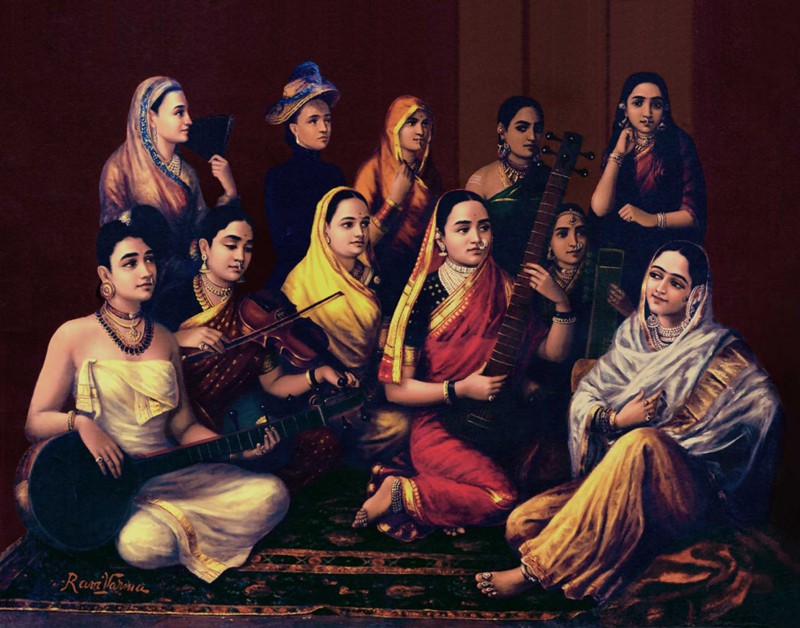
Galaxy of Musicians · Raja Ravi Varma · 1889
Oil on canvas · Salar Jung Museum, Hyderabad
"The same image that invites worship
also invites desire.
That duality unsettles the frame."
One might argue that Ravi Varma did not merely depict mythology. He re-scripted it through the optics of colonial modernity and bourgeois sensibility. His figures carry that contradiction: holy and human, revered and observed, devotional and theatrical.
In the early 20th century, his imagery became intertwined with emerging nationalist sentiment. His visualisations of gods and epics contributed to a shared cultural vocabulary that travelled across language, region, class, and the new circuits of print capitalism.
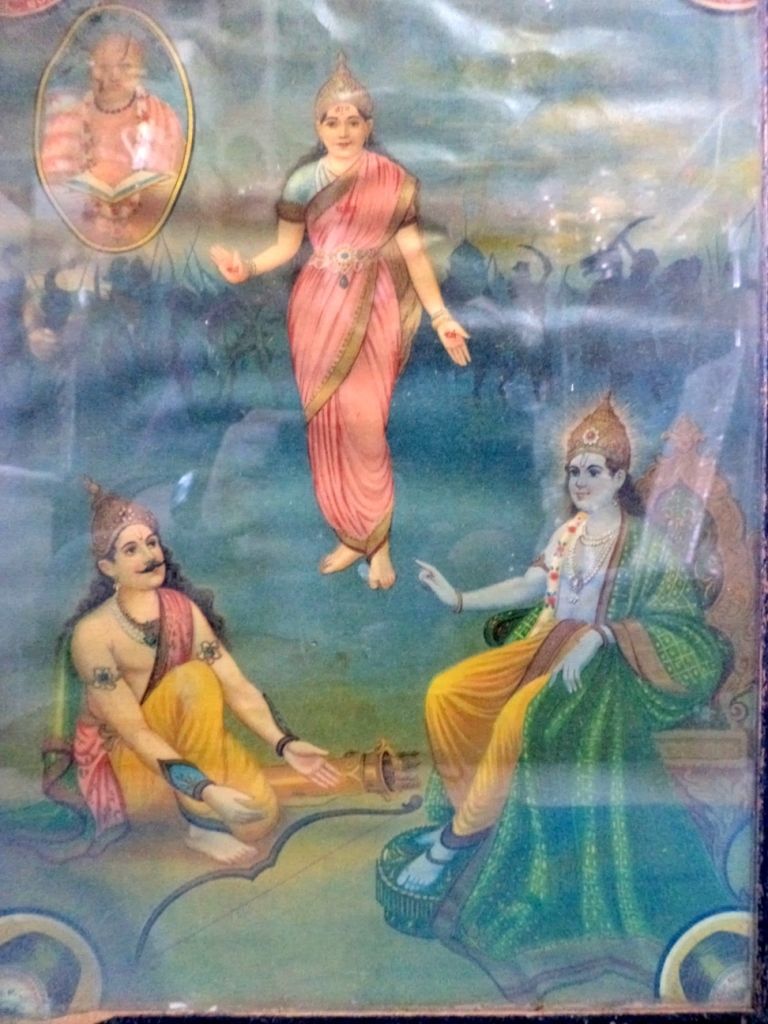
Sri Krishna and Arjuna · Raja Ravi Varma
Oleograph print
By the mid-20th century, modernist artists and critics began to reject Ravi Varma, viewing him as derivative of European styles and overly commercial. The rise of artists like M. F. Husain marked a deliberate departure from the naturalism and mythological literalism that Ravi Varma embodied.
And still, his images persist. They survive not in galleries alone but in everyday life: in temples, trucks, wedding invitations, prayer calendars, school notebooks, devotional posters, and shop walls. They have become part of India's visual subconscious.
The term calendar art should not be read only as dismissal but as diagnosis: a recognition of the moment when art became reproducible, accessible, and entangled with daily life. Ravi Varma collapses distinctions between elite and popular, sacred and commercial, art and commodity.
To write about Ravi Varma is to resist easy binaries. He is neither simply a pioneer nor merely a populist. He is both.
His discomfort lies in the deeper question of authenticity in a colonised culture. Is authenticity preservation of pre-colonial forms, adaptation of dominant global forms, or something unstable in between? Ravi Varma occupies that unstable space.